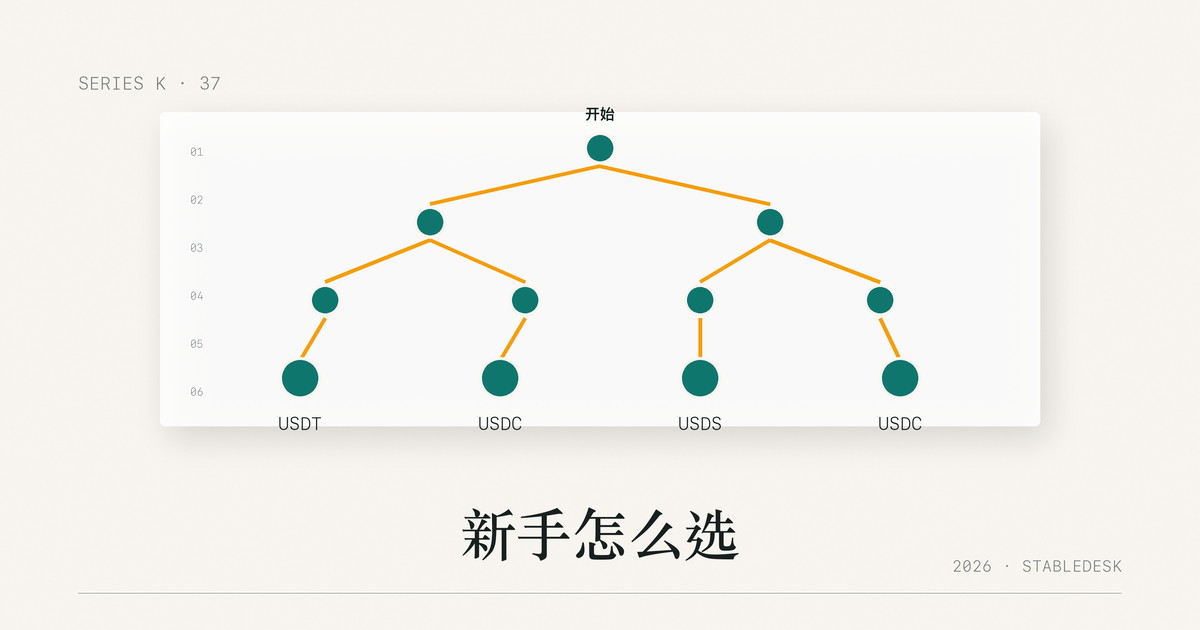
The four criteria, before the answer
Most beginners ask "which is the best stablecoin" and expect a one-word answer. The honest version is that "best" depends on four things you control:
Liquidity at your venue
Regulator and jurisdiction
Reserve quality and transparency
Use-case fit
Six common starting cases · the recommendation for each
You opened a Binance / OKX / Bybit account and want to buy your first dollar token
USDT is the lowest-friction default. Binance USDT spot pairs are the deepest in the market; nearly every asset has a USDT pair. Funding via P2P or card purchase routes default to USDT. For first purchases under a few thousand dollars, USDT is the path of least resistance.
→ USDT, on the chain your venue defaults to (typically BEP-20 on Binance for internal use, TRC-20 for external withdrawals)
You opened a Coinbase / Kraken / Gemini account in the US
USDC is the regulator-tight default. Coinbase offers zero-fee USDC-USD conversion both ways, which means you can move between USD and USDC at no cost. Kraken's USDC books are deep enough for most retail use. USDT trades on these venues but with less depth and more friction.
→ USDC, on Ethereum mainnet or Base for withdrawals
You opened an account on a MiCA-compliant exchange (Bitstamp, Kraken EU, etc)
USDT availability on EU-licensed venues has narrowed since MiCA came into force. USDC and EURC are the practical defaults. EURC is the right choice if you receive EUR salary and want to avoid the USD/EUR conversion friction on every transaction. USDC is the right choice if you need USD exposure for crypto purchases.
→ USDC (USD exposure) or EURC (EUR exposure), depending on your salary currency
You want to receive USD from a client in another country
USDT on Tron (TRC-20) is the dominant settlement layer for cross-border stablecoin payments in 2026. Fees are typically one USDT per transaction; settlement is two-to-five minutes; the receiver's wallet can be any Tron-compatible wallet including the major exchange accounts. The competing case (USDC on Solana or Base) is also workable but has narrower coverage among receivers in emerging markets.
→ USDT on Tron (TRC-20) for most receivers; USDC on Solana for tech-fluent receivers
You want to earn yield on a stablecoin in Aave, Compound or similar
USDC is the default collateral in most DeFi lending markets, with the deepest pools and the lowest borrow rates on Ethereum mainnet. USDT also works in most protocols but typically has slightly lower deposit rates. For a first DeFi position, USDC on Ethereum or Base reduces gas frustration and produces a more predictable yield.
→ USDC on Ethereum (large positions) or Base (small positions, lower gas)
You want to hold a stablecoin off-exchange for more than three months
The honest answer is: do not hold a single stablecoin in cold storage for more than three months. Split between USDT and USDC. The split ratio is less important than holding both. The reason is the SVB lesson — the two tokens fail in different ways and rarely fail at the same time. For positions above the threshold where the loss would meaningfully matter, the diversification is worth the small operational complexity.
→ Split: 50/50 USDT/USDC, on Ethereum mainnet, in a self-custody hardware wallet
The shortlist · what we actually consider for a first stablecoin
USDT (Tether)
Market cap roughly 150 billion as of mid-2026. The dominant unit on global spot exchanges. Reserves disclosed quarterly by BDO; mostly short-dated US Treasuries with smaller positions in corporate bonds, precious metals and digital assets. Has depegged briefly several times since 2017; has returned to peg each time and processed all redemptions. Regulatory posture is outside US state perimeters (BVI / El Salvador). Track record is the strongest argument; reserve transparency is less granular than USDC's.
USDC (Circle)
Market cap roughly 60 billion as of mid-2026. Dominant on US-regulated exchanges and in DeFi. Reserves disclosed monthly by Deloitte with CUSIP-level holdings of the BlackRock-managed money-market fund. Circle is publicly listed on the NYSE (ticker CRCL) and files SEC quarterly reports. Has depegged sharply once (March 2023, SVB weekend); recovery was fast but depended on a discretionary US government backstop. Regulatory posture is the cleanest of the major stablecoins.
FDUSD (First Digital)
Market cap around 2 billion as of mid-2026. Hong Kong-issued, HKMA-perimeter-friendly stablecoin. Reserves held in US Treasuries and overnight repos with a Hong Kong custodian. Useful inside the HK regulatory perimeter and on Binance's BTC/FDUSD pair (which has zero-fee trading). The smaller market cap makes FDUSD less suitable as a primary holding but useful as a hedge for HK-regulated holders.
DAI / USDS (Sky)
Market cap roughly 6 billion as of mid-2026 (combined DAI and the rebranded USDS). Crypto-collateralised, issued by the Sky Protocol (formerly Maker). Reserve composition is on-chain transparent and includes a meaningful share of USDC (which means DAI inherits some USDC risk). Useful inside DeFi; less useful as a CEX working balance because DAI books are typically thinner than USDC and USDT.
EURC (Circle)
Market cap roughly 200 million as of mid-2026. Circle's euro-denominated stablecoin. Same regulator (NY DFS / MiCA-registered through Circle's EU entity), same reserve composition philosophy as USDC. The right choice for EU residents who want to avoid USD conversion on every transaction. Liquidity is thinner than USDC; mostly useful within EU-licensed venues and a few DeFi pools.
PYUSD (PayPal / Paxos)
Market cap roughly 800 million as of mid-2026. Issued by Paxos on PayPal's behalf, regulated by NY DFS. Reserves in T-bills and overnight repos. Useful if you actively use PayPal for cross-border payments; less useful as a primary stablecoin holding because the venue coverage is narrower.
Three things to avoid as a beginner
1 · Stablecoins without a recent reserve disclosure
If the issuer has not published a reserve report in the last quarter, the stablecoin is not actively maintained at the standard a working desk would want. The disclosure cadence for USDT (quarterly) and USDC (monthly) is the floor; below that, you cannot price the risk.
2 · Algorithmic stablecoins
Pure algorithmic designs that maintain peg only through code do not exist at scale in 2026 and are excluded from the EU MiCA stablecoin category and the proposed US GENIUS framework. The desk's view is that they are a research category, not a holdings category. The full case is in our Luna postmortem.
3 · Small-cap stablecoins
Below roughly 100 million in circulating supply, a stablecoin is exposed to thin liquidity, narrow venue coverage and the operational risk of a small team running the issuer. There are interesting projects in this category but they are not first-stablecoin choices.
The first-thirty-days plan
The desk's working recommendation for someone holding zero stablecoins today, in roughly this order:
- Open an exchange account. For global users: Binance, OKX, Bybit. For US users: Coinbase, Kraken. Complete identity verification before depositing.
- Buy a small amount of stablecoin. Roughly 50 to 200 USD equivalent. The point is to learn the mechanics, not to take a position. For most users this is USDT on a global venue or USDC on a US venue.
- Withdraw to a wallet you control. Send 20 USDT or USDC to a personal wallet (MetaMask, Trust Wallet, Phantom on Solana). The first withdrawal teaches you the gas-fee structure and the wait time. Do this with a small amount to absorb the learning curve.
- Send back to the exchange. Round-trip the test. Confirms the wallet works, the chain selection is right and the deposit-credit timing on your venue is what you expect.
- Then decide on size. After the round-trip, you have done the operational learning. Now the question of "how much" is much easier to answer.
Mistakes the desk sees most often
Picking the wrong chain
USDT on Tron and USDT on Ethereum are the same token logically but live on different blockchains. Sending USDT-TRC-20 to an ERC-20 deposit address loses the funds. Most exchanges in 2026 detect the wrong-chain case for major chains, but the risk for less common pairings (Polygon, Avalanche, Arbitrum, Base) is real. Read the chain selector twice before pressing "send".
Confusing USDT and USDC at signup
The two tickers differ by one letter. Several exchanges have similar buy-flow buttons for both. The risk is buying USDT when you meant USDC or vice versa. The fix is operationally trivial (swap them on the spot pair) but produces an unnecessary fee. Read the ticker before confirming the order.
Treating stablecoin balance as a savings account
USDT and USDC do not earn interest by default. Holding a stablecoin in a wallet gives you the dollar exposure but no yield. The Anchor-style high-yield products that lured Luna holders into deposits are exactly the products to avoid. If you want yield on a stablecoin, the working options in 2026 are conservative DeFi lending (Aave, Compound at 3-5% APY in calm weather), or short-dated tokenised Treasuries via Ondo or BUIDL or similar — both have their own risks worth reading about before depositing.
The one-sentence answer for everyone else
If you skipped the rest of the article: open a Binance account if you are outside the US, buy USDT, learn the basics, then revisit this guide. Open a Coinbase account if you are in the US, buy USDC, learn the basics, then revisit this guide. The first stablecoin choice is reversible; the operational learning from the first thirty days is not.
If you want to act on this
The desk's working venue for global users is Binance for the operational reasons covered. The referral link opens a Binance registration page pre-filled with the StableDesk referral code BN16188. Registering through that link does not change your fees; Binance pays the referral service fee from its own marketing budget. The full disclosure is on the disclaimer page.
For US residents whose primary venue is Coinbase or Kraken, the referral does not apply and the framework above already accounts for that case.
Further reading on this site
- USDT vs USDC, the 2026 report — the six-dimension cornerstone, if you want the long form on the two-token choice.
- What is a stablecoin, in ten minutes — the primer covering the four families and how the peg works.
- The four stablecoin types compared — fiat-backed, crypto-collateralised, algorithmic, commodity-backed; deeper than the primer.
- Is a stablecoin safe? Four risks worth pricing — depeg, regulator, smart-contract and counterparty risk explained.
- Glossary — definitions for every term used in the articles.