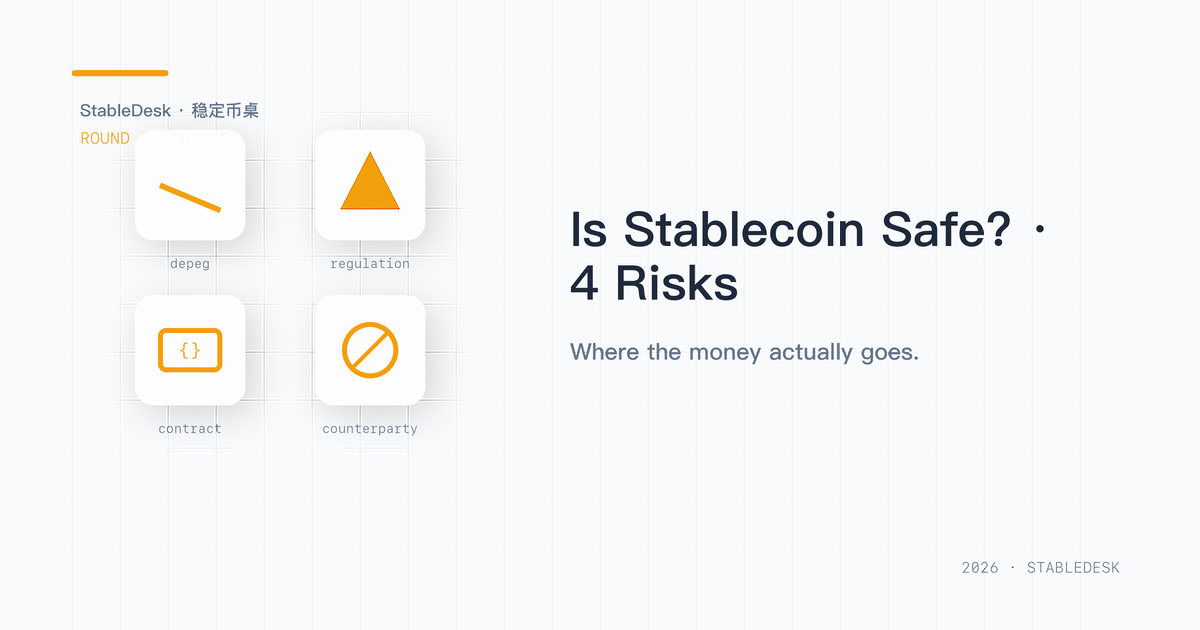
The frame · safe against what
"Safe" is a relative term. A stablecoin is safer than holding a volatile crypto asset like Bitcoin for the use case of holding a stable dollar value over a short period. It is less safe than a US Treasury bill held directly through a brokerage account because there are intermediate layers that can fail. The four risks below are the layers that can fail; understanding them lets you size your stablecoin position relative to your real alternatives.
Risk 01 · Depeg
The token trades below one dollar
What has happened historically. USDT has depegged briefly four times since 2017 (October 2018, March 2020, May 2022, briefly during 2023 banking stress). Each time recovered to peg within hours to days. USDC has depegged once severely (March 2023, SVB weekend, trough at 0.8774 on Coinbase). DAI has depegged in sympathy with USDC because of the USDC share in DAI's collateral mix. Luna's UST is the one permanent depeg in the major-name set, and Luna was an algorithmic stablecoin which is now effectively excluded from regulatory frameworks.
What makes a depeg more likely. A counterparty bank failure for the issuer (USDC / SVB), a regulator-forced wind-down (BUSD), a coordinated run against an algorithmic design (UST), or a sympathy depeg through cross-token collateral (DAI). For pure fiat-backed tokens with diversified reserves, the base rate is low; for algorithmic designs and crypto-collateralised tokens with concentrated collateral, the base rate is higher.
What does not necessarily cause a depeg. A general crypto market drop (USDT and USDC held peg through the 2022 bear market; the drop in BTC and ETH did not produce a stablecoin depeg). A negative news cycle about the issuer (Tether has weathered many such cycles since 2017). A delisting from one exchange (BUSD's delisting from Binance trading pairs in 2024 did not produce a market depeg because Binance phased it in carefully).
Risk 02 · Regulator-driven seizure or freeze
The issuer freezes your address
What has happened historically. Tether's cumulative frozen address count is above 1,400 since 2017. Circle's cumulative count is in the high hundreds. The majority are addresses associated with sanctions evasion, mixer protocols (Tornado Cash and similar), exchange hack proceeds, or specific criminal investigations. Both issuers publish at least partial logs of major freeze actions.
What triggers a freeze for a normal user. Almost nothing. The risk for a holder who has not interacted with sanctioned counterparties, mixer protocols or known-bad addresses is effectively zero. The risk increases if you receive funds from a counterparty whose source of funds is later traced back to sanctioned activity — your address can be frozen "downstream" of the original sanctioned actor.
The harder case. A regulator-forced delisting of an entire stablecoin — BUSD in 2023, USDT on EU venues since 2024 — is not a freeze of individual addresses, but produces similar economic effects on holders who cannot easily exit on their preferred venue. The mitigation here is venue diversification, not just token diversification.
Risk 03 · Smart-contract failure
The token contract or a wrapper protocol has a bug
What has happened historically. The USDT and USDC contracts on Ethereum mainnet have been deployed since 2018 (USDC) and 2017 (USDT, after migration from Omni) without a critical bug exploited at the token contract level. Both contracts have been audited multiple times. The same applies on most major chains where the tokens are deployed.
Bridge failures. Cross-chain bridges have been the source of the largest smart-contract losses in crypto. Wormhole lost roughly 320 million in February 2022, Ronin lost roughly 625 million in March 2022, Nomad lost roughly 190 million in August 2022, Multichain effectively rug-pulled in mid-2023 with losses around 130 million. Most of these losses included substantial stablecoin balances. Holders who bridged USDT or USDC through these protocols at the wrong moment lost real money.
DeFi protocol failures. Several DeFi protocols holding stablecoin deposits have failed for smart-contract reasons. Iron Bank had a freeze in late 2022. Euler was exploited for about 200 million in March 2023 (most recovered). Various smaller protocols have had episodic incidents. The recoverability depends on the specific incident and the protocol's design.
Risk 04 · Counterparty collapse
The exchange or lender holding your stablecoins fails
What has happened historically. The major exchange and lender collapses since 2014 cumulatively cost retail users billions. The biggest individual events:
- FTX (November 2022). Roughly 8 billion of customer assets missing. Stablecoin holdings on the exchange were caught alongside other assets. Bankruptcy proceedings have produced partial recoveries for customers but full recovery to USD value at the time of collapse remains uncertain.
- Celsius (June 2022, bankruptcy July 2022). Roughly 4.7 billion in customer assets. Stablecoin depositors were affected alongside other token holders. Restructuring plan distributions began in early 2024.
- Voyager (July 2022). Roughly 1.3 billion in customer assets. Recovery has been partial through bankruptcy proceedings.
- Genesis Capital (January 2023). Roughly 3 billion in customer assets including stablecoin lending positions. Partial recoveries ongoing.
- BlockFi (November 2022, after FTX exposure). Roughly 1.3 billion in customer assets. Substantial recovery achieved through 2024.
- QuadrigaCX (2019). Canadian exchange that lost roughly 190 million. The smaller scale obscures that the loss rate to customers was effectively total.
- Mt Gox (2014). The original exchange collapse. Roughly 850,000 BTC lost. Bankruptcy distributions to creditors began in 2024 — ten years later.
What this means in practice. The most likely way for a stablecoin holder to lose meaningful money in 2026 is not a depeg, not a freeze, not a smart-contract bug. It is leaving a balance on an exchange that fails. The risk is not specific to any stablecoin; it is specific to centralised custody.
The aggregate picture
Sorting the four risks by total dollar amount destroyed historically:
- Counterparty collapse. Order of magnitude tens of billions cumulative since 2014. Dominant risk vector for retail holders.
- Smart-contract failure. Order of magnitude billions cumulative, mostly from bridge exploits. Smaller than counterparty risk but larger than depeg events.
- Depeg events. Realised loss for holders who sold at the trough; mark-to-market loss for holders who held through. Hundreds of millions cumulative for fiat-backed; the Luna UST collapse adds tens of billions to the total if we include algorithmic designs.
- Regulator-driven freeze. Smallest aggregate dollar loss vector. Devastating for the small number of affected addresses; near zero for normal holders.
The intuitive ranking — depeg risk first, freeze risk second — is the opposite of the empirical ranking. Spend your risk-management attention proportionate to the empirical ranking: self-custody first, smart-contract caution second, diversification across tokens third, freeze risk fourth.
What a working risk policy looks like
- Working balance on a primary exchange: less than 5,000 USD equivalent for most retail holders, or whatever amount you would be operationally OK losing in a sudden insolvency event. This balance can be in a single stablecoin.
- Working balance on a secondary exchange: half the primary balance, for venue diversification.
- Self-custody balance: anything above working balance. Split between USDT and USDC, on Ethereum mainnet, in a hardware wallet. For holdings above roughly 50,000 USD, consider splitting across two hardware wallets.
- DeFi position: only what you can afford to lose to a smart-contract incident. Stick to protocols with multi-year track records and substantial total value locked.
- Long-term cold storage: same as self-custody but verified by a periodic test. Send a small amount in, send it back out, every six months. Confirms the seed phrase, the device firmware and the recipient address are all still operational.
The risks the desk does not lose sleep over
To balance the list above, three risks the desk thinks are overweighted in retail conversation:
- "USDT will collapse because Tether is unaudited." The token has been through every conceivable stress event since 2017 and processed every redemption it has received. The absence of a full audit is a fair criticism. The leap from "no full audit" to "imminent collapse" is not supported by the redemption track record.
- "USDC is a CBDC by another name." Circle is a regulated US fintech with public reporting. That is closer to a traditional banking-relationship product than to a CBDC. Real CBDCs (digital RMB, e-CNY) operate on different rails and have different surveillance properties. Conflating them obscures the actual risks of each.
- "All stablecoins will be banned." The regulatory direction in 2026 is toward tighter frameworks, not bans. MiCA constrains which stablecoins can be marketed in the EU but does not ban them. The proposed US frameworks (GENIUS, STABLE) are licensing regimes, not prohibitions. A holder who acts on "stablecoins will be banned" misallocates capital relative to the actual policy trajectory.
If you want to act on this
The most actionable item on the list is self-custody for amounts above working balance. Hardware wallets cost around 60-120 USD; the operational learning takes a few hours; the risk reduction relative to leaving balances on an exchange is substantial. For working balances, the desk uses Binance as a primary global venue. The referral link opens a Binance registration page pre-filled with code BN16188. Full disclosure on the disclaimer page.
Further reading on this site
- USDC SVB weekend, 48 hours hour by hour — the depeg case study in detail.
- Why algorithmic stablecoins fail — the Luna postmortem.
- Is USDC safer than USDT — the issuer-comparison version of the safety question.
- USDT vs USDC, the 2026 report — six dimensions including failure history.