The shortest possible definition
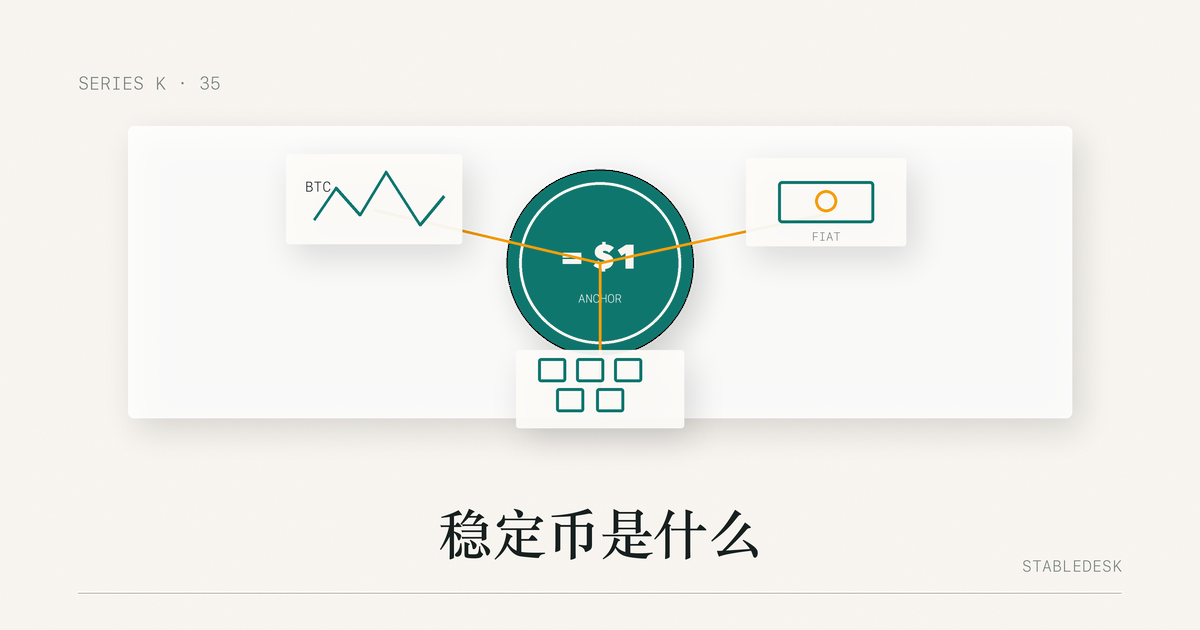
A stablecoin is a token that lives on a blockchain and is designed to trade at a stable reference price. The reference is almost always one US dollar; in a small number of cases it is one euro, one pound, one yuan, or one ounce of gold. The word "stable" describes the design goal, not a guarantee. Stablecoins can and do drift from the peg, sometimes for hours, occasionally for days, rarely forever.
Different stablecoins hold the peg in different ways. The differences are the most important thing to understand. Roughly:
- Fiat-backed. The issuer holds dollars (or T-bills, or money-market funds) one-for-one against each coin in circulation. USDT and USDC.
- Crypto-collateralised. The protocol holds other crypto (mostly ETH and USDC) at a ratio higher than one-to-one, and mints stablecoin against it. DAI / USDS.
- Algorithmic. No external collateral, or only partial collateral. The peg is supposed to be held by trading mechanics involving a second token. UST / Luna is the classic failure.
- Commodity-backed. Backed by physical gold, silver, or another commodity held in a vault. PAXG, XAUT.
The remainder of this primer takes each family in turn, explains how the peg works, and points at the most useful examples and the most informative failures.
Family one · Fiat-backed stablecoins
This is the largest family by supply. About 270 billion dollars of stablecoin floats around crypto in mid-2026; roughly 95% of it sits in fiat-backed designs.
How the peg works
The mechanic is straightforward. The issuer (Tether for USDT, Circle for USDC) accepts dollars from approved counterparties, parks the dollars in a reserve, and mints an equivalent quantity of stablecoin to the depositor. When a counterparty sends stablecoin back, the issuer burns it and returns dollars. Arbitrage does the rest: if USDC trades below 1.00 on an exchange, a counterparty buys it cheap and redeems for a dollar at Circle, banking the difference. If it trades above, a counterparty deposits dollars at Circle, mints USDC at par, and sells.
That arbitrage requires three things to work: the reserves have to be real, the redemption channel has to be open, and somebody has to want to do the arbitrage. When any of the three breaks down for long enough, the peg slips. The SVB weekend in March 2023 broke condition two (Circle's banking rails were closed for the weekend) and the price slipped from 1.00 to 0.87 in about eighteen hours. The peg recovered on Monday when the rails reopened.
The dominant examples
USDT (Tether). Issued by Tether Limited, incorporated in the British Virgin Islands. About 150 billion in supply, the largest single stablecoin by a wide margin. Quarterly attestation from BDO. Reserves heavy in US Treasury bills, with some corporate bonds, precious metals and other instruments. Dominant on global CEX order books (Binance, OKX, Bybit) and the working currency for most retail OTC and remittance flows outside the US.
USDC (Circle). Issued by Circle Internet Financial in the US. About 60 billion in supply. Monthly attestation from Deloitte. Reserves split between a BlackRock-managed government money-market fund and cash deposits at chartered US banks. Listed parent company since June 2024 (NYSE: CRCL). Dominant in US-regulated venues and in DeFi.
The full side-by-side reading lives in the USDT vs USDC report. The short version: USDC is more transparent on a line-by-line basis, USDT has a longer track record of surviving market shocks.
Smaller fiat-backed coins worth knowing
FDUSD. First Digital USD, issued under Hong Kong trust law. Stepped into the slot Binance left open when BUSD wound down. About 370 million in supply in mid-2026, smaller than at its 2024 peak. Useful inside the HK regulatory perimeter and for some Binance pairs.
PYUSD. PayPal USD, issued by Paxos. About 3.5 billion in supply. Notable because the distribution leverages PayPal's consumer footprint rather than crypto-native channels.
TUSD. TrueUSD, issued by Techteryx. Supply has fallen from about 3 billion to under 500 million on the back of repeated depegs and disclosure gaps. Use with caution.
BUSD. Binance USD, issued by Paxos. NYDFS ordered Paxos to stop minting new BUSD in February 2023. The token wound down over about eighteen months and is no longer the working dollar inside Binance.
EURC. Circle's euro-referenced stablecoin. Picked up market share after MiCA changed the European rules in 2024.
Where fiat-backed coins fail
Two main failure modes:
Banking-rail failure. If the bank holding the reserves goes down on a weekend, the redemption channel closes and arbitrage cannot work. SVB / USDC, March 2023.
Issuer regulatory action. If a regulator stops the issuer from minting new coins, the existing supply must wind down. NYDFS / BUSD, February 2023.
There are also "soft" failure modes — reserve composition that includes harder-to-verify assets, attestation gaps, jurisdictional opacity. None of these have produced a permanent depeg yet for the major fiat-backed coins, but they are the reasons readers care about which attestation, which auditor and which regulator.
Family two · Crypto-collateralised stablecoins
Smaller family, dominated by one design: MakerDAO's DAI (now also USDS under the Sky brand).
How the peg works
The protocol takes other crypto as collateral — ETH, USDC, real-world asset tokens — at a ratio higher than 100% (typically 150% to 175%). The protocol mints DAI against the collateral. When the collateral value falls toward the threshold, the protocol auctions it off to keep the system solvent. The peg is held by a combination of stability fees (a kind of interest on borrowed DAI), arbitrage against fiat-backed coins held in the system, and direct deposit modules that allow large counterparties to mint and redeem at par.
The system is partially decentralised — the rules sit in on-chain governance — and partially dependent on USDC. After the SVB weekend in March 2023, DAI briefly traded at 0.89 because a large fraction of its collateral was USDC, which was itself depegged. The peg returned with USDC's. MakerDAO has since diversified collateral further into US Treasury bill positions and similar real-world assets, reducing but not eliminating the USDC dependency.
The example
DAI / USDS. Issued by MakerDAO under the Sky umbrella since August 2024. About 15 billion in supply across DAI and USDS combined. Crypto-collateralised core with a real-world asset overlay. Default collateral in many DeFi lending markets on Ethereum.
For the operational reader, DAI matters because it is the largest stablecoin that does not rely on a single corporate issuer's banking relationships. Its failure modes are different: smart-contract risk, governance risk, collateral correlation risk. Its strengths are different too: it cannot be ordered to stop minting by a regulator (although the protocol could choose to comply with sanctions through governance).
Family three · Algorithmic stablecoins
This is the family that produced the most spectacular failure in crypto history.
How the peg was supposed to work
An algorithmic stablecoin tries to hold one dollar without holding one dollar of off-chain collateral per coin. Supply expands and contracts according to code. The most famous design — Terra's UST — used a second token (Luna) as the elastic absorber. When UST traded above one dollar, the protocol let arbitrageurs burn one dollar of Luna to mint one UST and sell it; when UST traded below, the protocol let them burn one UST and mint one dollar of Luna and sell that. In theory the supply of Luna stretched to absorb shocks.
The design relies on Luna having real market value at all times. If Luna's market cap drops below UST's circulating supply, the absorber cannot absorb. The system enters what the post-mortems call a death spiral: UST starts to depeg, the protocol mints more Luna to defend it, Luna's price falls, holders panic, more UST is redeemed, more Luna is minted, the price falls further. The arithmetic compounds quickly.
The Luna / UST failure, in five lines
- 2022-05-08. Large UST sell orders hit Anchor (the protocol's main deposit product, paying about 20% yield). UST slips to 0.987.
- 2022-05-09. UST falls to 0.65. Luna falls from 80 dollars to 30. The Luna Foundation Guard sells about 1.5 billion in Bitcoin reserves to defend the peg. The Bitcoin reserves are exhausted in roughly twenty-four hours.
- 2022-05-10 to 11. UST drifts down to 0.30, then 0.10. Luna falls from 30 dollars to 0.05.
- 2022-05-12. The Terra blockchain is halted briefly to prevent governance attacks. Luna prints from a 350 million supply to over 6 trillion as the protocol tries to keep absorbing.
- 2022-05-13. UST is effectively dead. Luna is effectively dead. About 60 billion dollars of paper value evaporates.
The Luna collapse rewrote how every regulator looks at algorithmic designs. MiCA explicitly restricts the structure. US federal proposals reference the episode by name. Several smaller algorithmic designs that survived 2022 (FRAX, USDD, USDN) have either moved toward collateral-backed structures or shrunk to insignificance.
Where they sit today
Algorithmic stablecoins are largely a closed chapter as of 2026. A handful of experiments persist — Ethena's USDe is the most-discussed, with a hedge-based design that sits somewhere between crypto-collateralised and algorithmic — but the category is small, novel and concentrated in DeFi-native use cases. For most readers, the practical takeaway is simpler: if a stablecoin pays you double-digit yield and the white paper talks more about token mechanics than about reserves, treat it with the suspicion the Luna story deserves.
Family four · Commodity-backed stablecoins
The smallest family. Tokens backed by physical commodity, usually gold.
PAXG. Pax Gold, issued by Paxos. One token corresponds to one fine troy ounce of London Good Delivery gold held in Brink's vaults. About 600 million in supply in mid-2026. Useful for crypto-native gold exposure.
XAUT. Tether Gold. Same structural design as PAXG, issued by Tether. Smaller supply, similar use.
Commodity-backed stablecoins are mostly used as a portfolio diversifier rather than as a working dollar. The peg fails in unusual ways: spot-vs-tokenised arbitrage windows, vault attestation gaps, redemption-minimum frictions. None of these have produced material price events for PAXG or XAUT to date.
What makes any peg actually hold
Across all four families, three ingredients hold the peg in normal weather:
- Arbitrage incentive. Somebody with capital must find it profitable to push the price back toward the reference. The smaller the gap and the friction, the more reliable this is.
- An open redemption channel. The arbitrageur must be able to exchange the token for the underlying (dollar, T-bill, ETH, gold) without delay. When the channel closes — bank weekend, regulator action, protocol pause — the peg can slip.
- Reserve confidence. Either through attestation (USDC monthly, USDT quarterly), audit (still missing for the major coins), or on-chain transparency (DAI's collateral is visible on Etherscan in real time).
When all three are present, the peg holds within fractions of a cent. When one is broken, the peg moves by single-digit percent. When two are broken, the move can be larger. When all three are broken — as in Luna's last days — the peg goes to zero.
How to think about which one fits which job
The four families are not interchangeable, but for most readers the practical question is narrower: which fiat-backed coin for which purpose. The short answer, from the cornerstone comparison:
- Day-to-day trading on a global venue: USDT.
- Day-to-day operations on a US-regulated venue: USDC.
- Yield in DeFi: USDC (default collateral in most lending markets).
- Cross-border via Tron: USDT (the only choice with material liquidity).
- Long-term cold storage: a mix. Holding only one issuer concentrates risk in one corporate counterparty.
For the longer treatment with twelve scenarios and the underlying reasoning, see the USDT vs USDC report. For the questions a new holder usually asks at this point, see the 20-question FAQ.
Five risks the primer should not skip
If this is the first stablecoin piece you have read, the following five risks are worth carrying away from the page.
Depeg risk. Even the largest fiat-backed coins have traded below peg under stress. The standard reference points are USDC at 0.87 (March 2023), USDT at 0.95 (May 2022) and DAI at 0.89 (March 2023). None caused permanent loss, but holders who needed to sell at the wrong minute did lose money.
Issuer freeze risk. Both Tether and Circle can and do freeze addresses in response to law-enforcement requests and OFAC sanctions. If your address is associated with a sanctioned counterparty, the coins held there can be locked, possibly permanently.
Venue risk. If you hold stablecoin on an exchange, you hold an IOU from the exchange rather than the on-chain token itself. The FTX collapse in November 2022 wiped out customer balances of every kind, including stablecoins. Self-custody removes this risk but adds others.
Smart-contract risk. DAI and other DeFi-native designs depend on smart contracts being free of exploitable bugs. The DeFi space has a long history of contract failures, including major incidents at protocols that had been audited. The largest DAI-relevant incidents have been resolved without permanent loss to DAI holders themselves, but the risk is non-zero.
Regulatory risk. Where you live changes the picture more than people expect. MiCA changed which stablecoins you can hold on EU exchanges. Hong Kong's ordinance is reshaping which tokens are licensable in HK. US legislation has been in motion through 2025-2026. The answer to "is this safe to hold" is partly a function of your jurisdiction's current rules and partly of where those rules are heading.
What to read next
If you want the deep comparison between the two coins you will actually hold:
- USDT vs USDC, the 2026 report — six dimensions side by side, the SVB weekend hour by hour, twelve scenario picks.
- Twenty questions a new holder actually asks — safety, custody, tax, on-ramps and off-ramps in a question-answer format.
- Glossary — plain definitions for every term used here.