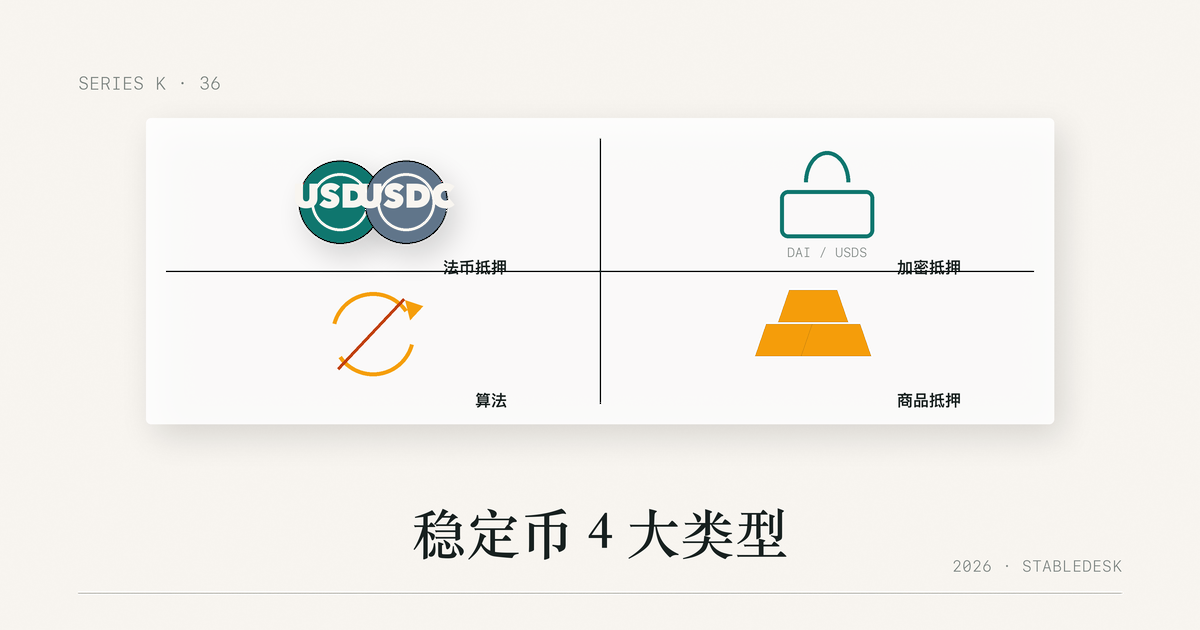
Family 01 · Fiat-backed
USDT, USDC, FDUSD, EURC, PYUSD
Family 02 · Crypto-collateralised
DAI, USDS (Sky), GHO, crvUSD, LUSD
Family 03 · Algorithmic
UST (defunct), USDD (hybrid), FRAX (now collateralised)
Family 04 · Commodity-pegged
PAXG, XAUT (gold); a few small oil and silver experiments
The cross-family comparison
| Dimension | Fiat-backed | Crypto-backed | Algorithmic | Commodity |
|---|---|---|---|---|
| Peg target | Single fiat (USD, EUR) | Single fiat (USD, EUR) | Single fiat (historically) | Commodity (gold, etc) |
| Reserve location | Off-chain, bank custody | On-chain smart contract | None (pure form) | Off-chain, vault custody |
| Verifiability | Attestations, periodic | On-chain in real time | Not applicable | Attestations, vault audits |
| Liquidity (2026) | Deepest | Moderate, DeFi-focused | Minimal | Thin |
| Primary risk | Counterparty bank, regulator | Collateral liquidation, smart-contract | Death spiral | Commodity-price, custodian |
| Survived 2022-2024 stress | Yes (with one painful exception, USDC in 2023) | Mostly, with DAI inheriting USDC contagion | No (Luna) | Yes, no major depegs |
| Regulator status | Increasingly tight; MiCA, NY DFS, MAS | Lighter; falls under DeFi frameworks | Excluded from MiCA, GENIUS | Specific commodity-token rules |
| Typical APY (calm market) | 0% (token itself); 3-5% in lending | 3-7% (Spark, Aave DAI pool) | Historically 15-20% (Anchor) | 0% (gold itself does not yield) |
| Best for | Working balance, cross-border, first stablecoin | DeFi, philosophy | Research | Gold exposure with crypto rails |
The history that explains why the categories settled here
2014-2018 · Fiat-backed dominates from the start
USDT launched in 2014 on the Omni Layer (later migrated to Ethereum, Tron and other chains). For four years it was effectively the only fiat-backed stablecoin with any market depth. The 2017 bull market produced the first major USDT controversies — questions about reserves, the relationship with Bitfinex, the role in BTC price formation. The questions did not slow USDT growth; the absence of alternatives kept the market concentrated.
2018-2020 · USDC enters; DAI grows; the framework forms
USDC launched in 2018 with a more regulated posture, immediately becoming the second-largest stablecoin. MakerDAO launched DAI in late 2017 with single-collateral (SAI), then migrated to multi-collateral (DAI) in November 2019. The framework of "fiat-backed vs crypto-collateralised" became clear; the algorithmic category was small and experimental.
2020-2022 · The algorithmic bubble
Iron Finance (TITAN), Empty Set Dollar, Basis Cash, Frax (initially partially-algorithmic) and several other algorithmic designs reached non-trivial size. Most experienced episodic instability. The defining event was Iron Finance's TITAN crash in June 2021, where the algorithmic stablecoin IRON traded below 0.75 and TITAN fell from 64 to near zero. The collapse was a clear pre-Luna warning; the market did not generalise the lesson.
May 2022 · Luna ends the algorithmic case
UST and Luna collapsed together. 60 billion of combined market cap erased. The contagion took down Three Arrows Capital, Celsius, Voyager and contributed to the FTX collapse later that year. The market for pure algorithmic stablecoins effectively closed. Hybrid designs continued but at lower market cap and with substantial collateral additions.
2022-2024 · Regulators codify what the market already learned
MiCA was passed in 2023 and came into full force in June 2024. The US discussed several stablecoin frameworks (GENIUS, STABLE, Clarity Act). The HK Monetary Authority published its stablecoin licensing framework. All of these excluded or constrained pure algorithmic designs. The category was effectively codified out of the regulated stablecoin space.
2024-2026 · Fiat-backed consolidation
Circle's IPO in June 2024 was the major structural event of this period. USDC moved from a private fintech to a publicly listed company with SEC reporting obligations. Tether continued to publish quarterly BDO attestations and accumulated one of the largest non-sovereign holdings of US Treasury bills. The two-token concentration (USDT + USDC at over 75% of stablecoin market cap) became the working norm.
Examples that do not fit cleanly
USDe (Ethena) and the synthetic-dollar category
Ethena's USDe (launched 2024) is sometimes called a "synthetic dollar". The mechanism uses ETH and BTC perpetual futures shorts to neutralise the USD value of the underlying assets, producing a near-stable token. The yield comes from funding rates on the perp shorts. It is not pure fiat-backed (no off-chain reserves), not crypto-collateralised in the DAI sense, not algorithmic in the UST sense. Some commentators classify it as a fifth category; the desk treats it as a hybrid worth watching but not yet a default holdings category.
Tokenised Treasury products (BUIDL, USDY, OUSG)
BlackRock's BUIDL, Ondo's USDY, Ondo's OUSG and several similar products are tokenised holdings of short-dated US Treasuries. They are not stablecoins in the traditional sense — they pay yield, the on-chain price reflects accrued interest, and the holder is buying a tokenised security rather than a payment token. They are increasingly used as a stablecoin alternative for treasury management; the desk does not classify them as stablecoins for the purpose of this article.
RLUSD (Ripple) and the late-entrant fiat-backed category
Ripple's RLUSD launched in December 2024 as a NY DFS-regulated fiat-backed stablecoin. It sits in the same family as USDC and PYUSD but has narrower venue coverage as of mid-2026. Useful inside the Ripple / XRP Ledger ecosystem; less useful as a primary holding because of liquidity depth.
What the desk uses, by family
To put a working stake in the ground:
- Fiat-backed working balance. USDT on Binance for global venue trading, USDC on Coinbase / Kraken for US-regulated venue use. Split is roughly 60/40 USDT/USDC depending on the week.
- Crypto-collateralised DeFi position. Small DAI position used in specific Aave borrow contexts and in MakerDAO's PSM module. Not a primary holding.
- Algorithmic. Zero. The desk has held no algorithmic position since the Luna collapse. The category is not a holdings category.
- Commodity-pegged. Small PAXG position as a gold proxy with crypto-rail composability. Not for stablecoin-equivalent use; classified as a commodity position in the portfolio.
If you only remember three things
- Fiat-backed dominates because the trade-off (off-chain custody for on-chain liquidity) is the best fit for the dominant use case (working capital for crypto activity).
- The "decentralised stablecoin" debate is partly philosophical: DAI inherits USDC risk through its collateral mix, which means the practical difference between a USDC position and a DAI position is smaller than the marketing suggests.
- Algorithmic stablecoins are a category that the market has, in 2026, voted against. The regulators have codified the vote. New designs that claim to solve the algorithmic problem deserve careful reading; the historical track record of the category is not encouraging.
If you want to act on this
For a working stablecoin balance, the operational defaults are USDT on a global venue (Binance most common) or USDC on a US-regulated venue. The Binance referral link opens a registration page pre-filled with the StableDesk referral code BN16188; registering through that link does not change your fees. Full disclosure on the disclaimer page.
Further reading on this site
- What is a stablecoin, in ten minutes — the primer if you want the shorter introduction.
- USDT vs USDC, the 2026 report — six-dimension cornerstone for the fiat-backed deep dive.
- Why algorithmic stablecoins fail — the Luna postmortem in detail.
- How to choose your first stablecoin — the four-criteria decision tree.
- Glossary — definitions for every term used.